The Problem
35 years of research
At some point you stopped asking for help and just became the system.
That worked. Until it didn't. The Second Shift Method™ gives working mothers a structural way out: ready-made workflows for every domain you manage, built by someone who has been exactly where you are.
37 hrs/wk
Unpaid labor gap, dual-income households
McKinsey · 2023
25 min/day
Real uninterrupted leisure for working mothers
OECD · 2023
A Tuesday in the data
Tuesday at 4:47 p.m.
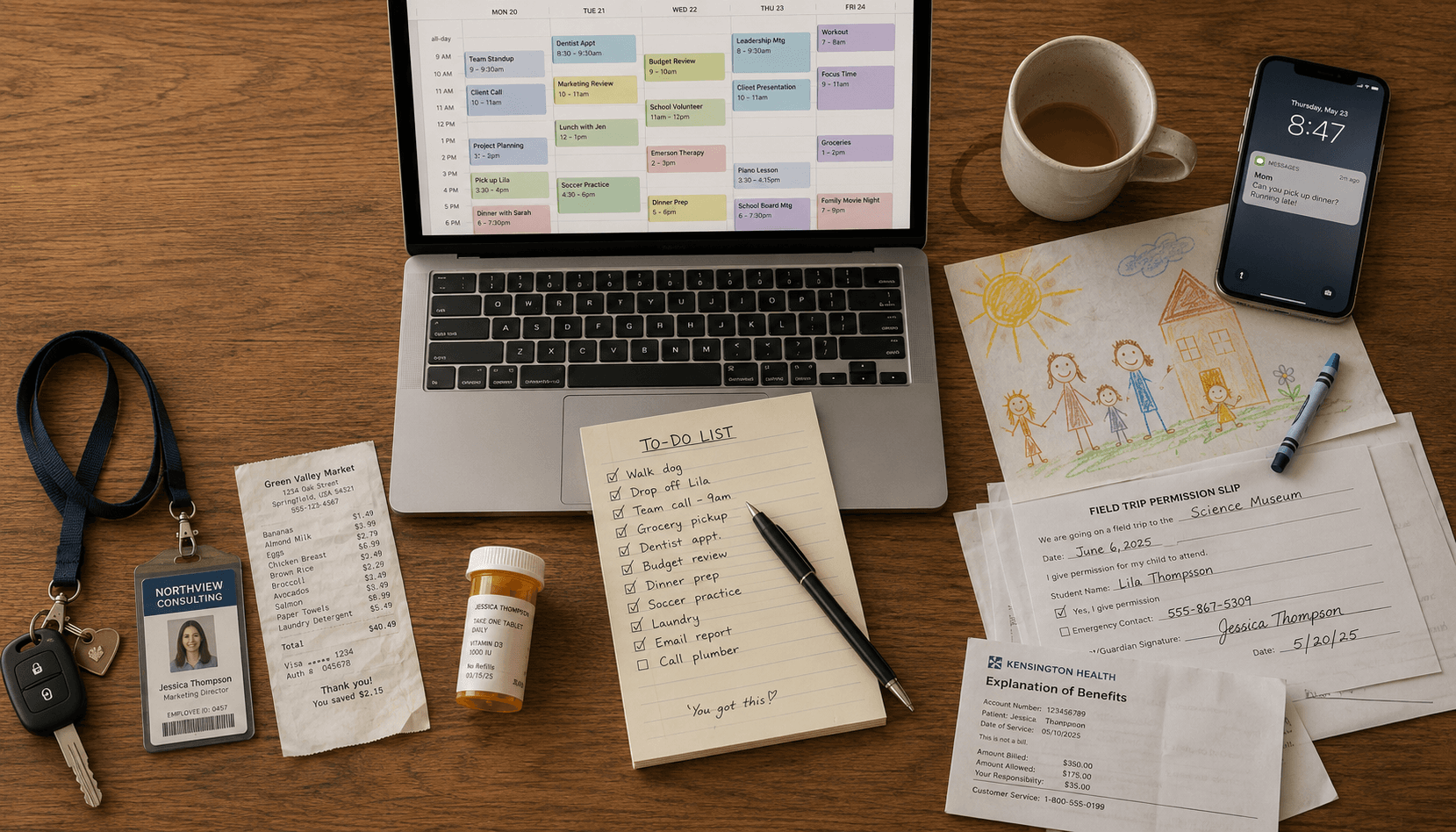
It is 4:47 p.m. on a Tuesday. The school portal pings about a permission slip due tomorrow. The text from the orthodontist confirms an appointment that overlaps with Wednesday's science fair. The Slack channel from work lights up about Q3 numbers. The chicken in the freezer is still frozen. The babysitter cancels for Saturday. You have eighteen open browser tabs and a thirteen-tab head.
Nothing on that list is hard. Each item takes two minutes. The problem is that everything routes through one person, at once, with no system behind it. Work with no name on a paycheck and no line on a resume. Here is what 35 years of research has measured about it.
Every industry that pays for itself has software. The unpaid second shift never got the same tools. Mothers are not failing at it. There has never been a system to plug into.
Sound familiar? Start here.In your head at 4:47
- Permission slip due tomorrow
- Orthodontist conflicts with science fair
- Q3 numbers in the work Slack
- Frozen chicken, no plan B
- Saturday babysitter just cancelled
- Eighteen tabs, all important
This is what it costs
Thirty-five years of research. One very consistent finding.
Economists, sociologists, and time-use researchers have measured the second shift for decades. The numbers shift by country and year. The pattern does not. Working mothers carry more of it, track more of it, lose more to it. In hours, in earnings, in the margins of their own lives.
37 hrs/week
Unpaid labor gap between working mothers and their partners in U.S. dual-income households.
McKinsey and LeanIn.org Women in the Workplace, 2023
4 hrs 25 min
Average daily time women globally spend on unpaid care work. Men: 1 hr 23 min.
ILO Care at Work, 2023
98 hrs/week
Total unpaid labor performed by the average U.S. stay-at-home mother. Equivalent to two and a half full-time jobs.
Welch's / Bright Horizons stay-at-home mom labor study
25 min/day
Real uninterrupted leisure available to working mothers.
OECD Better Life Index
$11 trillion
Annual global value of women's unpaid care work, priced at minimum wage.
ILO, 2023
$178K/yr
Estimated market-rate value of a U.S. stay-at-home mother's total annual labor across cooking, childcare, logistics, and household management.
Welch's / Bright Horizons stay-at-home mom labor study
Sources: McKinsey and LeanIn.org Women in the Workplace 2023. ILO Care at Work 2023. OECD Better Life Index. Welch's / Bright Horizons stay-at-home mom labor study.
The mental load
The work you do before any of the work is even visible.
Time-use studies count tasks. The thinking that precedes them is what they miss. Allison Daminger, in the American Sociological Review in 2019, split it into four parts: anticipating, identifying, deciding, and monitoring. Across her 35 dual-income couples, women carried the load in roughly three of every four areas of household life.
A 2023 University College London and University of Bath study found mothers carry 13.72 active mental tasks on average. Fathers carry 8.2. Mothers handle 71% of mental load tasks, and it holds even when the mother out-earns the father.

What the categories of invisible work actually look like.
Thinking ahead for everyone
The work of thinking ahead. What will be needed, what might go wrong, what to prepare. Daminger found women perform roughly 88% of anticipatory household planning. This is the work that wakes you up at 4 a.m.
Daminger, American Sociological Review, 2019
The cost of handing work off
Hand off a task and you usually keep the monitoring. The cognitive cost of monitoring rivals doing the task itself. This is why asking for help rarely reduces the load.
Daminger, 2019; Rodsky, Fair Play, 2019
Administrative load
Insurance paperwork, medical records, school forms, appointment booking, utility setup, account management. Bureau of Labor Statistics time-use data puts this at 6 to 8 hours per week in dual-income households with children.
U.S. Bureau of Labor Statistics, American Time Use Survey, 2023
Social and emotional coordination
Birthdays, RSVPs, thank-you notes, teacher relationships, neighbor logistics, friend dynamics across kids. Almost never measured because it resists measurement. Almost always defaulted to the mother.
Hochschild, The Managed Heart, 1983; Daminger, 2019
Contingency planning
Every backup plan lives in one person's head. Who picks up if practice runs late. What to cook when the plan fails. Where the spare key is. Who to call when the sitter cancels. Constant. Invisible. Yours.
Daminger anticipation stage, 2019
The notification layer
Apps, portals, newsletters, group texts, signups, deadlines. For mothers of school-age children, this digital admin layer runs 45 minutes to an hour a day. It hides as background noise. It is work all the same.
Pew Research, Parenting in the Digital Age, 2023 (framework); Common Sense Media parent-tech research
Sources: Allison Daminger, “The Cognitive Dimension of Household Labor,” American Sociological Review, 2019. Eve Rodsky, Fair Play, 2019. Arlie Hochschild, The Managed Heart, 1983. U.S. Bureau of Labor Statistics, American Time Use Survey, 2023. Pew Research Center, Parenting in the Digital Age, 2023.
Decision fatigue
Decision fatigue hits harder when you're deciding for the whole family.
35,000
Decisions the average adult makes per day.
Wansink and Sobal, Cornell, 2007
227
Of those, about food alone.
Cornell, 2007
Roy Baumeister, who named decision fatigue, showed the brain has a finite daily decision budget. Once spent, decision quality drops, and the prefrontal cortex, home to self-control and executive function, goes quiet.
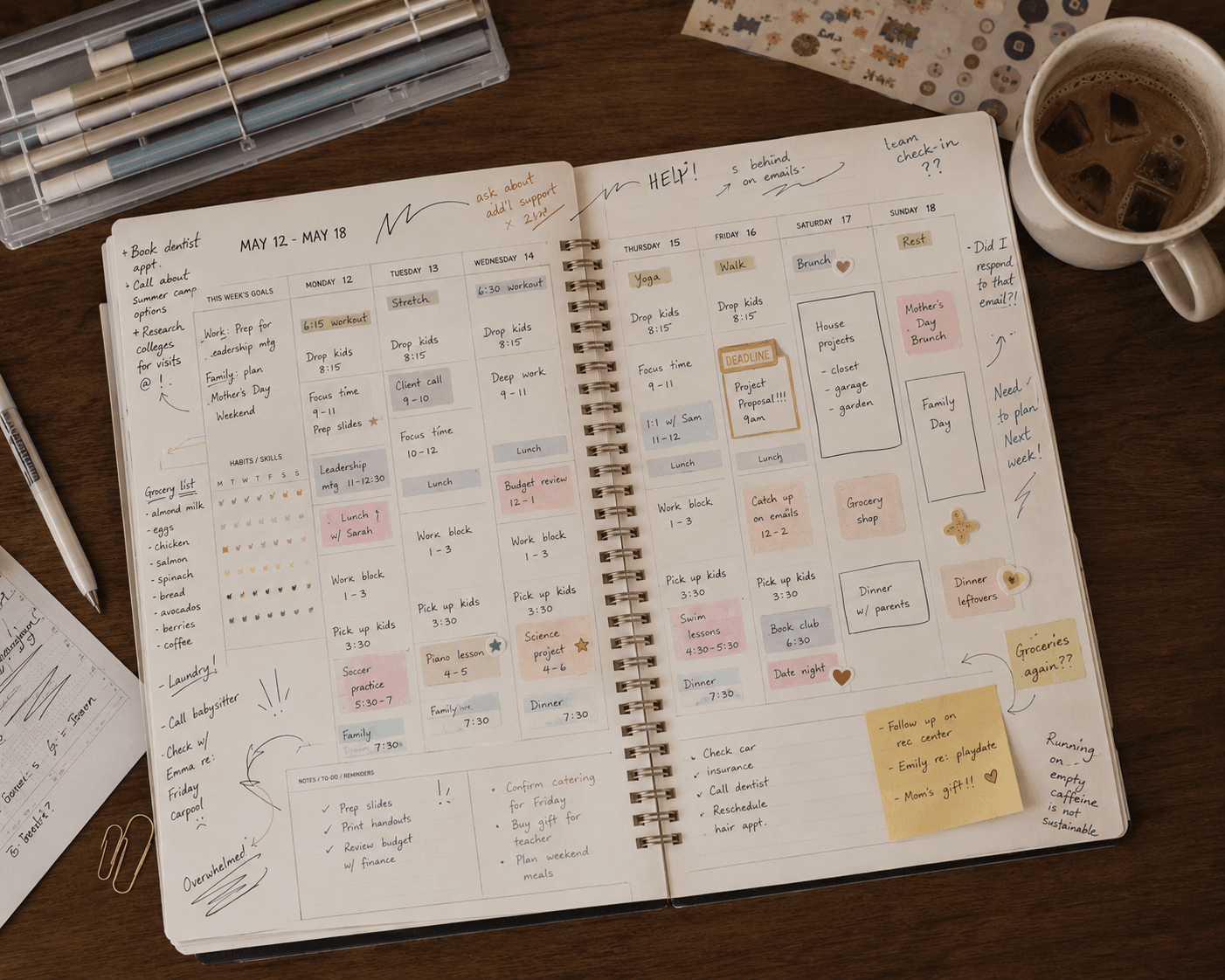
Mothers are the household's decision concentrator. The food, the schedule, the activities, the clothing, the gifts, the emotional triage all run through one person. By 4 p.m. your decision budget is spent. The late-day fog is depletion doing its job, the same way it would for anyone.
The structural reality
The load persists regardless of pay grade or how the dishes are divided.
When couples redistribute physical chores, the cognitive load stays with the mother. A partner takes the task; the planning, anticipating, and tracking behind it stay with whoever already did them. The cognitive layer is structurally separate from the physical one, and closing the first gap rarely closes the second.
Successful career women have not closed this gap because it comes down to infrastructure, and the infrastructure went everywhere else first.
Sources: University of Bath, 2024. Daminger, 2019.

The cost
The bill comes due.
The bill comes due in wages, in burnout, in leisure.
Personal cost
What she earns next to a working father, full-time.
Of the entire gender pay gap is the motherhood penalty alone.
Knocked off her earning power for each child under five.
Lifetime total
$600,000Lost across a 30-year career, next to a working father with the exact same hours.
Bankrate, 2024. Federal Reserve Bank of St. Louis.
Scale
more likely than fathers to carry most of the housework and caregiving, on top of the same job.
McKinsey and LeanIn, Women in the Workplace
of working mothers report symptoms of burnout in any given year.
Maven Clinic State of Motherhood, 2024
The bill comes due in wages, in burnout, in leisure. Working mothers have been paying it alone for decades.
Until now.
You can't change the structural reality. You can stop paying the part that belongs to infrastructure. The Second Shift Method™ is the system every other industry already has.
Sources: Bankrate, 2024. Federal Reserve Bank of St. Louis. Mothers in America Report / University of Phoenix, 2024. Maven Clinic State of Motherhood, 2024. McKinsey and LeanIn, Women in the Workplace.
5 free workflows
No account. No card.
42 paid workflows
One library, every category.
Any AI tool
ChatGPT, Claude, Gemini, Copilot.
You review everything
Nothing runs without your approval.