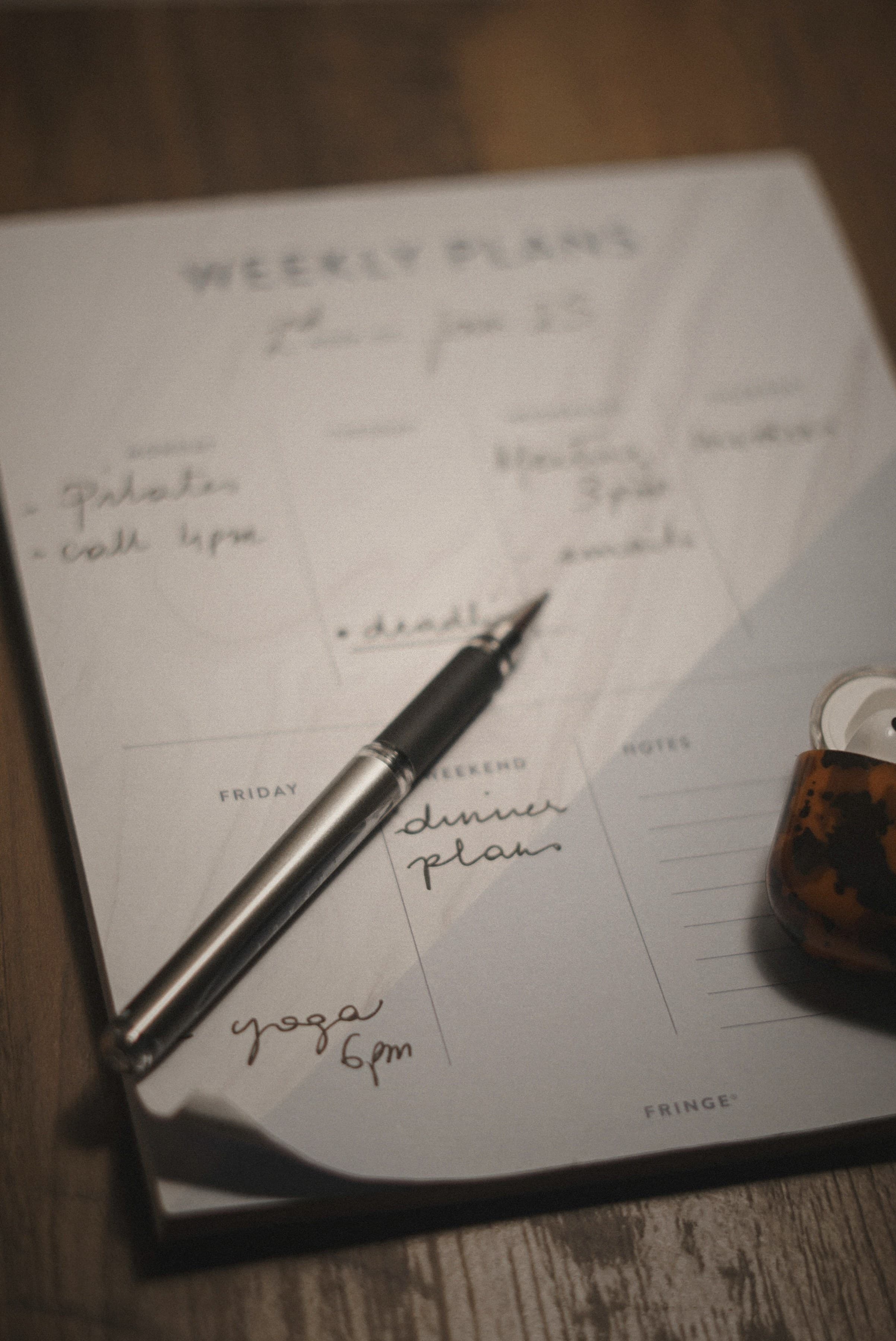
There is a drawer in your kitchen where the organizing systems go to die. The label maker from January. The family planner with twelve gorgeous blank months and three filled-in ones. The binder with the color-coded dividers. The app you set up over one hopeful Sunday and stopped opening by the second Tuesday. Every one of them worked for about two weeks. Then the upkeep outran the attention you had to give it, and it slid off the side of your life like everything before it.
The story you have probably told yourself is that you are bad at organization. Wrong story. Every system in that drawer had the same design flaw: it handed you an empty container and asked you to build it and maintain it forever on your own attention. For a brain that runs low on exactly that resource, you were set up to fail. There is another kind of system, and it holds when your focus does not, because it supplies the structure instead of demanding it.
Why the systems keep sliding off
Look closely at the planner, the binder, and the app. They are all the same object: a blank container with your name on it and an unspoken contract. The contract reads, you will remember this exists, you will return to it every day, you will keep it current by hand, and you will do all of that without any reminder from the thing itself. That is a heavy contract for anyone. For someone whose working memory and follow-through are already spoken for, it is a contract you were going to break, not because you are careless, but because it was written against your grain.
The cruel part is the timing. These tools work beautifully at the start, during the burst of energy that comes with a fresh system, which is exactly when you decide this time will be different. Then the novelty wears off, the daily upkeep becomes invisible work with no reward attached, and the structure decays the second you look away. You did not fail the system. The system asked for steady, unprompted maintenance you were never going to have, and it broke on schedule.
Worth knowing
Quick test for whether a system will last you: ask what happens the first week you ignore it. If it falls out of date and you have to rebuild from scratch, it will not survive, because that week is coming. The systems that hold are the ones that stay true while you are not looking.
The shift: a system that supplies the structure
So stop hunting for a better empty container. Look for something that already has the structure, asks you the questions instead of waiting for you to know them, and holds the answers so you never have to rebuild them. The job you are bad at is inventing structure out of thin air. The job you are good at is answering a specific question when something puts it in front of you. A setup that fits your attention does the first job for you and only ever asks you to do the second.
This is the difference between a blank planner and a guided setup. The blank planner says, organize your family, and leaves you staring at a void with twelve months in it. A guided setup asks, what is your daughter's teacher's name, what size shoe does your son wear now, who is the pediatrician, what is the allergy, which night is the impossible one. You can answer every one of those in five seconds. You just could never face the blank version, because the blank version asked you to invent the shape first.
What a structure-supplying system looks like in practice
A system built for the way your attention actually works has a few specific traits. They are the opposite of what the dead planner had. When you are picking the next thing to try, these are what to look for.
It asks, it does not wait
The system prompts you for each piece of information in turn, so you are reacting to a question instead of generating a structure from nothing. Reacting is the mode your brain is good in. Initiating from a blank page is the mode that stalls, and a system that never makes you start from blank removes the exact step where you used to freeze.
It captures standing facts once
It focuses on the things that stay true: names, ages, sizes, schools, doctors, the standing schedule, the allergy, the food that causes a meltdown. Those facts barely change. Right now you reload them from memory a hundred times a day. Writing them down once, in one place, means the upkeep is close to zero, which is the only level of upkeep any system can ask of you and survive.
It does not punish a gap
You can ignore it for a week and nothing breaks, because it is holding facts that did not change while you were gone. You come back and it is exactly where you left it, still true, no rebuild required. A system you can walk away from and return to without penalty is the only kind that lasts a real year of a real life. The dropped week stops being the thing that kills you.
It hands the facts to the rest of your week
Once the standing facts live in one place, everything downstream can draw on them instead of asking you again. The meal plan already knows the allergy. The calendar already knows the early-release day. The school form gets handled without you first digging six facts out of memory. The structure you supplied once keeps paying out across every other task, and that is what makes a small setup worth doing.
This is exactly what the Family Profile is built to do. It is a free, one-time, guided setup that walks you through your household one question at a time and stores the standing facts in a single place. You are never staring at a blank page. You are answering questions you already know the answers to, and the structure builds itself around your answers as you go.
Try a system that builds the structure for you
The free Family Profile asks you the questions and holds the answers, so you are never building or maintaining an empty container. One sitting. Done.
Open the free workflowWhy this works when willpower did not
Every system in the drawer asked you to supply two things: the structure and the discipline to maintain it. A structure-supplying system asks for neither. It brings its own structure, it asks for facts you can produce on demand, and it keeps them current without a daily ritual you have to remember. You are not fighting your own attention to keep a blank planner alive anymore. You answered the questions once, and the answers stayed answered.
Notice what that does to the story you have been telling yourself. The drawer full of abandoned planners was never proof you cannot get organized. It was proof that you kept being handed the wrong tool, one that ran on a fuel you did not have a surplus of. Give the same person a tool that runs on a fuel they do have, the ability to answer a clear question, and the organization that never stuck before just holds.
You were never bad at organization. You were handed empty containers and asked to fill and maintain them out of the one resource you had least of.
If you do one thing this week, make it the one that does not require you to build or maintain anything. Sit down with the Family Profile, answer the questions it asks, and let it hold your household's standing facts in one place. It is free, it takes one sitting, and it is the on-ramp to the rest of The Second Shift Method™, the workflow library members use to take the invisible work off their plate one piece at a time.
Start with the setup that asks instead of demands
The Family Profile is free and built to supply the structure for you. Members get the full library of workflows that carry the rest of the mental load without asking you to maintain a single thing.
Start free with the Family Profile